Pricing plays a crucial role in the cargo industry, directly influencing profitability, market competitiveness, and customer satisfaction. Effective cargo pricing strategies are essential for optimizing revenue generation while maintaining a balance between customer demands and operational costs. In this article, we will explore the strategies and approaches that can empower cargo carriers to succeed in this dynamic and challenging landscape, with help from DoubleBlaze.
The Importance of Cargo Price Optimization
Optimizing cargo pricing is a multifaceted approach that requires a deep understanding of industry dynamics, market conditions, and the intricacies of cost structures. For cargo carriers seeking to thrive, achieving the right balance is essential. DoubleBlaze Consulting is poised to provide the guidance and strategies necessary to strike that balance effectively.
Pricing Objectives and Considerations
Studies have consistently highlighted the significance of aligning cargo pricing strategies with specific objectives. Whether it’s revenue maximization, market share expansion, or cost recovery, DoubleBlaze Consulting can help you implement pricing strategies that precisely meet these objectives, offering cargo carriers a roadmap to profitability.
Accurate cost estimation is equally crucial. Underpricing or overpricing can have detrimental consequences. DoubleBlaze Consulting excels in employing advanced methodologies, including activity-based costing, to ensure that pricing accurately reflects the costs associated with cargo services.
Market-Based Pricing Excellence
Market-based pricing strategies have proven to be pivotal in capturing customer value while considering competitive offerings. DoubleBlaze Consulting’s team of experts understands market dynamics, demand elasticity, and competition, enabling them to create pricing strategies that are not only competitive but also aligned with customer value.
Optimizing Revenue with DoubleBlaze Consulting
A significant advantage that DoubleBlaze Consulting brings to the table is its expertise in revenue management. Cargo carriers often employ revenue management strategies borrowed from the airline industry to optimize pricing and capacity allocation. Dynamic pricing models, such as yield management and capacity-controlled pricing, allow carriers to adjust prices based on real-time demand information. This ensures optimal utilization of available capacity and maximizes revenue, a feature that can significantly enhance cargo carriers’ profitability.
Enhancing Customer Satisfaction and Loyalty
The use of bundling and packaging strategies to enhance cargo pricing effectiveness is another domain where DoubleBlaze Consulting shines. By combining different services or offering value-added packages, carriers can create price differentiation and attract customers with varying needs. These strategies not only help increase customer satisfaction and loyalty but also contribute to optimizing revenue streams.
Navigating Complex Pricing Scenarios
For cargo carriers involved in intermodal transportation, where multiple modes of transportation, such as air, sea, road, and rail, are utilized, pricing decisions can be particularly complex due to diverse cost structures and service characteristics across modes. DoubleBlaze Consulting suggests coordinated pricing models that consider intermodal connectivity, cost-sharing arrangements, and service integration. These considerations are essential for ensuring profitability and competitiveness in intermodal cargo transportation.
E-Commerce Logistics Pricing Strategies
The growth of e-commerce has introduced unique pricing challenges for cargo carriers, particularly in the context of last-mile delivery and returns management. DoubleBlaze Consulting tailors pricing strategies to meet these specific challenges, exploring dynamic pricing, surcharging, zone-based pricing, and other techniques specifically tailored to e-commerce logistics. These approaches aim to address cost inefficiencies and provide competitive pricing options while meeting customer expectations for quick and reliable deliveries.
Conclusion
Cargo pricing strategies are vital to the success and sustainability in cargo operations. DoubleBlaze Consulting, with its in-depth knowledge and expertise, is your ideal partner in this endeavor. By understanding the nuances of cost structures, demand, competition, and customer preferences, DoubleBlaze Consulting can assist cargo carriers in making informed pricing decisions that optimize revenue generation, maintain competitiveness, and meet customer expectations in the dynamic cargo industry.
The dynamic nature of the cargo industry necessitates ongoing research and adaptation. Further exploration of emerging pricing models, in response to evolving market dynamics and technological advancements, is a task that DoubleBlaze Consulting is well-equipped to undertake on behalf of its clients.
Unlock the full potential of your cargo pricing strategies with DoubleBlaze Consulting as your trusted partner. Contact us today to embark on a journey toward optimized revenue, profitability, and customer satisfaction.
Before diving into AI/ML implementation, your company will need to conduct an initial assessment. This phase involves identifying specific business challenges, opportunities, and goals that AI/ML can address. DoubleBlaze Consulting specializes in this step by using their industry templates to tailor solutions to your unique needs.
Data Preparation: ML/AI relies on data to uncover hidden patterns and insights. Expect to invest time and effort in data preparation. This may involve data cleansing, integration, and ensuring data quality. The better your data, the more effective your AI/ML implementation will be.
Visualization and Interpretability: AI/ML models developed by DoubleBlaze Consulting prioritize decision support over black-box recommendations. Expect to have tools and visualizations that allow you to understand and interpret the AI/ML insights. This transparency is essential for building trust and confidence in the recommendations.
Focused Problem Solving: ML/AI should be applied to well-defined and understood business problems. Avoid the temptation to use AI for everything; it’s not a silver bullet. Instead, focus on problems that can benefit the most from AI/ML optimization. DoubleBlaze’s industry templates can help identify these areas.
Pilot Projects: Expect the implementation to start with a pilot project. This is a small-scale test of the AI/ML solution using a limited dataset and specific business goals. It allows your team to understand the practical implications and value of AI/ML in a controlled environment.
Customized Solutions: DoubleBlaze Consulting offers industry-specific templates to tailor AI/ML solutions to your needs. Expect these templates to be customized to your business’s unique challenges and goals. The goal is to provide you with a solution that fits your business like a glove.
Incremental Improvements: Don’t expect immediate, dramatic changes. AI/ML implementation is an iterative process. Over time, you can expect incremental improvements as you fine-tune the algorithms and models to your business environment.
Long-Term Value: AI/ML is not a one-time project but an ongoing process. You should expect long-term value from your investment. As you gather more data and refine your AI/ML models, the benefits should continue to grow.
Business Transformation: As you implement AI/ML solutions, expect a transformation in your business processes. It may lead to changes in pricing strategies, inventory management, customer engagement, and more. Be prepared for organizational changes to fully realize the value of AI/ML.
Data Security and Privacy: Implementing AI/ML also comes with data security and privacy considerations. Expect to invest in data protection measures to ensure that customer data and business information are safeguarded.
User Training: Your team may need training to make the most of the AI/ML tools and insights. Be prepared to invest in training programs to ensure your employees can use these tools effectively.
Measuring Success: Define key performance indicators (KPIs) and expect to continually measure the success of your AI/ML implementation. Adjust your strategy as needed to achieve the desired outcomes.
By setting these expectations, your readers will have a clear understanding of what to anticipate when implementing AI/ML solutions in the retail industry and how DoubleBlaze Consulting’s services can help them navigate this transformative journey.
Staying ahead of the curve is imperative with today’s competitive market. Retailers recognize the potential of harnessing Artificial Intelligence (AI) and Machine Learning (ML) to redefine their strategies, but many find the journey fraught with challenges. Traditional approaches, such as costly enterprise software solutions and hiring data scientists who may not grasp the nuances of your business, often fall short of delivering the desired value.
Enter DoubleBlaze Consulting. With a wealth of industry experience and a deep-rooted understanding of data science, we’ve crafted industry-specific templates that pave the way for harnessing the power of AI and ML, making it accessible to businesses with a modest initial investment and rapid returns. Our retail analysis offering is Enterprise Pricing, an innovative set of templates designed to optimize your pricing strategies. But how does it work, and what can you expect from our services?
The Blueprint for Retail Transformation: DoubleBlaze’s Services
At DoubleBlaze Consulting, one of our missions is to help retailers transform their operations using AI and ML, and we offer a range of services to achieve this goal. Here is the value each template can bring to your retail business:
Broad Analysis of Items:
To embark on your AI/ML journey, we begin with a comprehensive analysis of your product catalog. This involves determining Key Value Items (KVIs), the cornerstone of our approach. KVIs represent the top X% of items that yield the most significant returns. However, we don’t stop at KVIs alone; we have the flexibility to expand the analysis to include other categories such as Slow Movers, Background items, and Foreground items. These category definitions may vary from one business to another with many businesses already having some idea of KVIs. However, this categorization is often based on legacy knowledge or subjective opinions.
Basket and Cross Sell Analysis:
Understanding customer behavior is pivotal in retail. Our basket and cross sell analysis dives deep into the correlation between items, shedding light on what your customers typically purchase together. For example, if a customer buys peanut butter, there might be a 75% chance they’ll also purchase jelly (an illustrative example). Or in apparel if the customer buys a particular blouse there could be a higher chance they would buy an accessory. The real value lies in uncovering more subtle connections that might be overlooked in traditional basket and cross sell analysis. By understanding the composition of your customers’ intended purchases, you can plan cross-product promotions, bundles, pricing adjustments, and more intelligently enhance your customer experience.
Elasticity Study:
Price changes can significantly impact your sales and profitability. Our elasticity study aims to provide insights into which products are more sensitive to price changes and which are not. It connects this analysis with your KVIs and cross sell analysis, resulting in a concept we call “basket elasticity” or for apparel, “cross sell elasticity.” In essence, if a KVI item is both a purchase driver and highly responsive to price changes, altering its price can have a substantial impact on complementary items. This understanding allows for smarter decisions on pricing, promotions, and assortment planning.
Recommendations:
Ultimately, our goal is to provide you with a tool that can recommend optimal prices, incorporating elasticity and ML insights into the decision-making process. While this is a work in progress, the vision is to create an analysis template that can seamlessly integrate with your pricing tool, acting as an “add-on.” This add-on can optimize your top KVIs or other strategically important items, which drive a significant portion of your revenue and profits. It can potentially function as a stand-alone tool or work alongside your existing pricing solutions, depending on your business’s unique needs.
In conclusion, DoubleBlaze Consulting is not just another service provider. We are your partner in retail transformation, offering a suite of services that empower your business with the intelligence and insights needed to thrive in a dynamic marketplace. By embracing AI and ML, you can navigate the challenges of the modern retail world and unlock new opportunities for growth, efficiency, and customer satisfaction. Your journey with DoubleBlaze starts here, and the possibilities are boundless. This is how to get started.
In today’s rapidly evolving retail landscape, it’s no secret that Artificial Intelligence (AI) and Machine Learning (ML) are set to revolutionize the way companies plan and strategize. Retailers understand that the future lies in harnessing the potential of AI and ML, but the path to realizing its full value has challenges. Traditional enterprise software solutions are often too costly and time-consuming to implement, and they only excel in specific scenarios. Alternatively, hiring in-house data scientists can be problematic as they often lack the nuanced understanding of the retail business domain, requiring extensive subject matter training to become truly effective.
This is where DoubleBlaze Consulting steps in, offering a smarter way forward. Drawing upon our extensive industry experience and data science expertise, we’ve devised specialized industry templates that enable your retail company to harness the power of AI and ML without the massive upfront investment and protracted timelines. One of our core solutions, Enterprise Pricing, exemplifies the potential these technologies hold for your business.
Demystifying AI/ML for Retail: How It Works
The keys to realizing the benefits of AI/ML within Enterprise Pricing can be broken down into several essential elements:
Data: The Fuel for AI/ML
AI and ML success or failure is completely reliant on data. The tools excel at uncovering concealed patterns and relationships within large datasets. While these technologies can work with incomplete data, their true potential shines when fed with well-managed, high-quality data. Expect the initial stage of your AI/ML journey to involve data preparation and cleansing, ensuring your data is in optimal shape for analysis.
Visualization: Transparency and Clarity
One of the hallmarks of our approach is providing decision support rather than black-box recommendations. Transparency is key. Our solutions come with visualization tools that enable you to understand and interpret the insights generated by AI and ML. This empowers your team to make informed decisions based on clear, comprehensible data.
Focused Problem Solving: Tailored Solutions
The crux of AI/ML implementation is to apply these technologies to well-defined and understood business problems. Avoid the temptation of using AI for everything; instead, focus on areas where it can make the most significant impact. Our industry templates are designed to pinpoint these problem areas, ensuring that the resources you invest in AI/ML are maximized for tangible results.
Piloting Your AI/ML Journey
Embarking on your AI/ML journey typically begins with a pilot project, a small-scale test of the technology’s capabilities using a limited dataset and specific business objectives. This stage serves as a stepping stone, offering a glimpse of what’s possible and how AI/ML can directly benefit your retail company.
What to Expect from Our Industry Templates
Our industry templates offer tailored solutions for your unique challenges. Here’s a glimpse of what you can anticipate:
Identifying and Correcting “Insult Pricing” and “Give-Away” Pricing: Detect and rectify pricing strategies that may harm your business by underestimating or over-discounting your products.
KVI Optimization Template: Ensure your pricing strategy doesn’t leave potential profits on the table by optimizing key value items (KVIs).
Pricing Zone Template: Boost your margins by fine-tuning your price zones to reflect the market’s demands and customer preferences.
ML/AI Basket Analysis & Cross Sell Analysis: For businesses with mature processes, this tool identifies hidden relationships in item purchases and uses elasticity to increase margins on groups of items commonly purchased together.
In summary, embracing AI and ML in your retail business is an opportunity to gain a competitive edge, but it requires the right approach. DoubleBlaze Consulting offers a clear roadmap, combining industry expertise and advanced data science to help your business unlock the true potential of AI and ML in a cost-effective and time-efficient manner. Your journey starts with understanding the data, gaining transparency through visualization, and focusing on specific business problems, all of which will be facilitated by our industry templates. Expect a gradual transformation that promises long-term value and a brighter future for your retail enterprise. Click here for more on our retail industry templates and here on how to get started.
In today’s ever-changing manufacturing landscape, pricing specialists face unique challenges in maximizing revenue for their products. DoubleBlaze, a leading pricing specialist with a proven track record, can empower you to understand which strategies are working, which ones need adjustment, and which ones require an overhaul. Below, we will discuss how DoubleBlaze can help answer these questions for you and assist you in taking control of your pricing strategies.
Comprehensive Analytics Solutions for Manufacturers
Manufacturers recognize the importance of data-driven decision-making. DoubleBlaze specializes in providing comprehensive analytics solutions tailored for manufacturers, bridging the gap left by traditional data sources. Our team can empower your business users with advanced analytics capabilities, including competitive price indexes, price comparisons with competitors, customer segment analysis, demographic analysis, rebates, contracts, and other relevant information.
Modern Infrastructure Implementation
Whether you are working with an existing infrastructure or starting from scratch, DoubleBlaze has you covered. Our experts can seamlessly integrate a data pipeline framework, establishing a robust data lake. Utilizing cutting-edge tools like DataBricks and DBT, we create bronze, silver, and gold data transformations, providing you with unparalleled access to insightful data.
Visualizing your data is crucial for making informed decisions. Top-tier reporting platforms like Tableau, PowerBI, and Looker enable a powerful reporting infrastructure that offers clear, actionable insights for your business. We can implement these tools in conjunction with the data pipeline or on their own to provide your analysts with the tools they need to make better decisions.
Track Record of Success
Here are some of the tools we can implement to empower your analytics team as manufacturers:
Advanced Sales Analytics
Leverage modern technologies to unlock the full potential of your sales data.
Tailored implementations allow for in-depth analyses of sales history and competitive price indexes for your products.
Custom analysis options effectively address specific manufacturing challenges.
Customized Infrastructure
Flexibility is key in data management. We can adapt our services to your existing infrastructure and provide cutting-edge data pipeline frameworks when you are looking to revamp your systems.
We transform data into bronze, silver, and gold data levels using tools like DataBricks and DBT for maximum efficiency.
Actionable Insights through Analysis
We help manufacturers establish robust analysis infrastructures using platforms like Tableau, PowerBI, and Looker.
Comprehensive data visualization leads to informed decisions that fuel business growth.
Manufacturing Revenue Analytics Approach
Our approach to manufacturing performance analytics is a step-by-step process that ensures success:
Data Lake Ingestion
The process begins with the establishment of a robust data lake, capturing a comprehensive range of data, including sales figures, forecasts, product prices, discounts, promotions, rebates, credits, and competitive revenue data.
Collaboration with clients is essential for defining specific data points that align with unique analytics needs.
Data Transformation
Meticulous data refinement into more structured formats makes it easier to analyze and extract valuable insights. We transform data into bronze, silver, and gold levels for further analysis.
Advanced Statistics
Integration of advanced statistical techniques, such as product elasticity and variance from forecasts, provides a richer understanding of revenue strategies.
Machine Learning Integration
With a solid framework in place, DoubleBlaze introduces machine learning techniques to uncover hidden patterns and further optimize revenue strategies.
Summary
In the competitive world of manufacturing, DoubleBlaze stands as a trusted partner in revolutionizing pricing and revenue strategies. Our comprehensive analytics solutions, modern infrastructure implementation, and robust reporting infrastructure have consistently delivered actionable insights and unprecedented success for manufacturers. Don’t miss the opportunity to elevate your manufacturing business to new heights—connect with DoubleBlaze today and embark on a journey towards unparalleled success in the realm of pricing strategies and revenue optimization.
In the dynamic world of holiday package pricing for travel and hospitality companies, revenue management poses a significant challenge. Traditional demand forecasting models often fall short, struggling to reflect competitive price differences and adapt to rapidly changing market conditions. In this blog post, we’ll explore the complexities of revenue management in the context of tour package pricing and how innovative solutions are reshaping the industry.
Challenges in Existing Demand Forecasting Models
Ineffectiveness: Traditional models fail to provide accurate forecasts, especially for package products with multiple components.
Competitive Price Differentials: They often overlook the critical factor of competitive pricing differences, which can significantly impact demand.
Complexity: The conflicting demand for each component within a package further complicates forecasting.
Slowness to Adapt: These models are slow to respond to changes in the competitive landscape or market situations, resulting in missed opportunities.
Challenging Assumptions: The assumption that price increases close to the arrival date is always effective is not always accurate.
The Goals: Automated Recommendation Processing
To tackle these challenges, the goal is to enable automated recommendation processing in revenue management. This approach aims to:
Quantify Strategic Objectives: Provide a framework to quantify strategic objectives and apply them consistently.
Define Rules: Define rules for various scenarios, eliminating the need to review each recommendation manually.
Empower Revenue Management: Shift the focus from micro-management to strategy development.
Tour Package Pricing Overview
A successful revenue management solution consists of several key components:
Representative Package Model: Selects essential packages to optimize markup/margin by flight, property-key room type, and room night.
Price Response Model: Develops a ‘win’ probability curve based on price and price differentials compared to key competitors.
Component Optimization Model: Utilizes Mixed Integer Optimization (MIP) to generate optimal price recommendations for flight and hotel components. It simulates how these changes impact representative packages.
Aggregate Markup Maximization: The best component prices are determined by maximizing the expected probability of winning customers over competitors, leading to aggregate markup optimization.
What Do We Optimize?
The solution optimizes a combination of flight and hotel mark-ups to achieve the overall optimal price. Factors to consider include:
Cross-Network Effects: Increasing flight mark-up affects all packages at a destination, while hotel mark-up impacts all points of origin for the same destination.
Length of Stay: Flight and hotel markup effects may vary based on the length of stay, which competitor pricing is not linearly dependent upon.
Balancing Act: Recommendations must balance between increasing margins and the impact on different package components.
Example of Post-Optimization Rules
To fine-tune recommendations, post-optimization rules are applied:
Volume and Profitability: Rules are defined to index responses to deviations from target volume or profitability.
Margin Adjustments: Pricers apply rules to adjust margins up or down from the optimized value to achieve volume or profitability objectives.
Special Cases: Rules may also apply for bulk overrides, promotions, room type variations, and controlling distribution channel availability.
Solution Benefits
The implementation of this automated solution brings significant benefits to hoteliers, resort operators, and package tour providers:
Demand Flexibility: It caters to industries with challenging demand forecasting and less dependence on days to arrival.
Tailored Strategies: Different product lines can be managed with unique strategies, addressing risk and non-risk inventory effectively.
Consistency: Maintains consistent decision-making and reduces the reliance on specific revenue management skills.
Conclusion
The challenges of revenue management in the tour package industry are met with innovative solutions that prioritize automation, data-driven decision-making, and optimization. By leveraging technology and advanced modeling, businesses can not only navigate the complexities of demand forecasting but also thrive in a competitive landscape. The transformation of revenue management is reshaping the industry, empowering businesses to achieve their strategic objectives and maximize profitability.
Grocery pricing can get complicated quickly. With a lot of products, tough competition, and fickle consumers, pricing is one of the most important levers a merchandiser can pull to increase margin and drive revenue. But, you already know that. How specifically can you improve pricing?
When we analyze pricing we first try to understand the process. For instance:
Are there competing prices and how conflicts are resolved?
Do multiple systems own pricing? One system for day to day pricing, a different one for promos, and a third for overrides at the store?
How are competitive prices analyzed and responded to?
What is the promo process?
Once we understand the landscape, we tackle the problem spots. Below are some common issues we find and how we address them.
Too Many Owners of Prices
In grocery, many retailers have organically built systems that handle pricing. In some cases, there might be one platform for permanent prices and a second for promotions. Then, day to day pricing analysis might be done on spreadsheets and a custom built system moves those prices to stores. Another process could be in place for manager’s specials at the store level. All these different sources of prices make it hard for merchants and category managers to get a holistic view of prices which can lead to profit leaks and lower margin. We address this by consolidating the different systems into a single one that simplifies the process.
Resolving Competing Prices
A second area where we see profit leaks is in competing prices. What is a competing price? A lot of pricing is often done in silos which results in multiple valid prices for an item at the same time. For example, in one grocery store we had the following competing prices:
Regular Retail
Weekly Special
Hard Limit Discount
Store Manager Special
Clearance
A winning price had to be selected for the item and store combinations. When there are multiple systems that can set prices, the correct price doesn’t always win which can lead to confusion with customers and store associates. We solved this problem by putting in a rules based pricing system that resolves conflicts. In some cases the hierarchy of price rules wins and in others the best price wins.
Publishing Prices
Once the prices are set, how do they get to downstream systems? Prices must get to point of sale systems, eCommerce, tagging systems, printers, store operations, and other users of prices. Sometimes millions of prices need to be published in a short time. Many grocers struggle with the volume of prices that need to go downstream and there are delays in getting prices out. If an incorrect price or price change needs to be sent intraday, it can take hours. We solve this by using a system that is optimized for making millions of calculations per hour and can operate in parallel to generate prices quickly. Also, in some cases, we have put systems in place that allow stores to make real time calls to a central pricing service which greatly improves efficiency. We have also implemented a hybrid approach where eCommerce calls real time and stores get prices through a batch process.
Manager’s Special
Store managers have to adjust some prices on a daily basis. Fresh produce is a prime example of where they might elect to discount when produce is about to expire or doesn’t look fresh. Also, store managers might find out about a competitor’s promotion that the central pricing team is unaware of which could prompt a discount match. Whatever the reason, store managers need to be able to discount at their discretion. When allowing for these updates, the central system needs to be aware of the discount and then propagate the new price down to the stores. We have solved this by putting in a central system which allows the store manager to enter the new price, reason for the change, capture the competitive price if available, and go through an approval process with the central pricing managers. The price is then immediately visible in the store systems once approved.
Pricing Against Competition
Understanding competitor’s prices is paramount to doing analysis and setting the correct price. Without accurate competitor prices, you are flying blind. Second to that is what your competitive strategy is. What is your process for gathering competitive data and who are your main competitors in a market? Are you always trying to beat your competitor’s price on a certain category? Are you trying to stay slightly above a competitor? We help grocers answer these questions and put in a process for analysing competitive prices, setting rules for pricing against competitors, and review the sales performance after the prices are in place.
Promo Management and Optimization
What is your promotion process? Are there cross organizational teams that execute promotions? How do you coordinate dependent activities such as printing, advertising, tagging, and outbound campaigns along with pricing? How do you analyze the promotional lift and coordinate with your supply chain? Do you have trade funds that can offset marketing costs and how do you account for that when you’re analyzing your promotion? Many companies address these questions with spreadsheets and emails which limits the effectiveness of the campaign. We help grocers fix these processes and give them the tools they need to optimize their prices leading to much more effective campaigns.
Clearance Pricing Optimization
Do you have expiring items, limited inventory or end of season items? What is your process for clearance pricing? Are you following a prescribed discount schedule or optimizing price based on local inventory and sell through? Better clearance pricing can improve profit up to 10% on these items. In many cases, grocers will follow a prescribed discount schedule which leaves money on the table. We help grocers by putting in a system that analyzes local conditions and optimizes the price for that store or zone.
These are just some of the tools and techniques we use to help grocers price better. Every company is different and may have solved some, but not all of these processes. When working with customers we tailor a plan to address the most pressing or profitable need first in short business releases. This delivers business results quickly which we then follow on to address the remaining problem spots. Contact us if you would like us to perform a free analysis to determine where your opportunities are.
If you would like more information on our approach, take a look at our in-depth pricing discussion here and here are some of the vendors we have used for pricing tools – BlueYonder and Rubikloud.
We strive to help customers achieve pricing excellence and in turn make more profit through better pricing. Here, we explain the different parts of the process with respect to retailers through a series of info-graphics.
Journey to Pricing Excellence is where the journey starts. How do you get from where you are now to achieving a culture of pricing excellence? In this document we explain at a high level how we guide you along that path.
Next, what are the specific questions that better pricing can help you answer and how does that affect your business? We align this to our pricing excellence path starting with the question a strong pricing execution foundation can solve.
What if 1% of your prices were wrong? This collateral describes the problems associated with pricing errors and the process we go through to understand the impact of pricing errors.
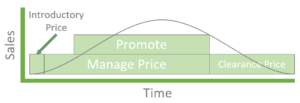
Next, we look at the different pricing activities merchandisers and marketers manage during a product life cycle. First, a product is introduced with a price, next the price is managed day to day, promotions are used to elevate awareness of the products, and finally at the end of life a clearance price is used to sell through inventory.
Can selective clearance pricing improve margins 10%? The final chapter in the series focuses on markdown or clearance pricing where you have finite inventory and want to maximize your goals when selling through.
These documents scratch the surface on how better pricing can help your business. We discuss many of these topics in more detail and how to implement pricing projects in our blog. Visit it here and share your thoughts.
Structurally, a pricing project isn’t much different than many enterprise software projects. Planning is the key to success. The first step is to work with the client team to develop an implementation strategy that works for all parties. The plan would have a firm scope for the first phase and potential scope for subsequent phases. This allows you to be agile as new information and situations come to light.
An implementation strategy will help guide the project and should address the following:
Document the expected drivers of benefit and the changes that enable and sustain those benefits
Define the business functions each application will cover during each phase
Define the data flows and integration methods between the applications for each phase
Assess the risks and plan mitigations to keep the project on track
In addition, implementation success factors should be discussed. Some of the factors that might be included are:
Involve key business users throughout the project. Users aid in defining requirements, setting scope, reviewing prototypes, performing acceptance testing, training other team members.
Keep implementation phases small. Phases should focus on a “minimally viable product” approach to manage risk and maximize the opportunity to learn and adjust as you go.
Maintain a consistent team from start to finish. This allows you to maintain institutional knowledge, minimize handoffs, more effectively support live issues and modify earlier work when needed.
Next, what are the pricing pain points you are trying to fix? When we identify the pain points, we will also estimate the financial benefit or productivity gain expected from addressing the issue. If you went through the process of identifying your pricing errors and analyzed the causes, you will have a good idea of what your pain points are. Here are some typical pricing pain points that we have seen in implementations:
Prices aren’t making it to stores quickly and reliably
Customers are demanding instant access to their loyalty points and stored coupons
Network connections are unreliable to the stores and often go down
There are potential price conflicts or margin leaks between price changes, promotions, markdowns, and coupons
Prices are managed in complex spreadsheets and there is an associated risk of making pricing errors often with the processes
The need to keep prices and promotions across channels aligned
These are some example of pain points that might exist in an organization. As mentioned, this list can be distilled from the analysis exercise of determining where your pricing errors are coming from. The list might also contain tangential pain points that aren’t directly causing pricing errors, but do cause frustration with the team that manages prices.
Rather than a big bang approach we subscribe to many different business releases that focus on key functionality. But where do you start? For our projects, we initially use a broad brush to identify how complex the different features are and balance that against the pain points. A business release would have well defined benefits that are attributed to specific feature requests. There are typically many different business areas you could start with for example a specific set of features, brand, geography, set of stores, or channel. We typically look at the following criteria in deciding where to start:
Start with a quick win. Often one of the best places to start is something that would address one or more key pain points and keep the timeline short. If you sized the complexity of the features and cataloged the pain points, you should be able to gauge what would be a quick win.
Understand the quality of the current data sources. Poor data quality is an issue with most projects and can bog down any timeline. A quick assessment of where and how to get the data, what kind of holes exist, and what kind of transformation should feed into your assessment of complexity.
Supportive business group. Another factor is what business groups are supportive of change and have the bandwidth to help drive the early implementations. If key personnel aren’t available such as business owners, users, or IT staff then your timeline could be in jeopardy.
Participation. Determine what level of participation the business can provide during the project.
Competing projects. Determine if there are other active projects that would impact the same resources or systems.
Other priorities. Are there any business priorities that would need to take into account? In retail, we often deal with back to school or black Friday and have to plan around those events to ensure we aren’t impacting those critical times.
All of these factors should be taken into consideration when determining where to start. Once you nail down the initial business release, you can plan it in detail to determine the expected timeline and cost. At the same time, you should identify the future business releases you expect to follow. You don’t have to plan the future releases in depth but should have a rough idea of complexity and cost which will drive your overall resource allocation and budget.
If you’ve done your homework and are confident you have a pricing opportunity, it’s time to start thinking about a project. Depending on what you’re doing, the project could be extensive or it could be a quick hit. We’ll cover scoping the project in the next articles, but first some things to avoid. Pricing projects, like any enterprise project, are subject to similar pitfalls that can be avoided or mitigated to ensure a successful project. In our experience, here are some of them:
No executive sponsorship. Pricing projects are resource intensive and touch a lot of parts in an organization. Without executive sponsorship, these projects rarely have a chance. Clear leadership helps align key resources that need to contribute on the project and ensures you have their attention.
Competing priorities. In one company, the leadership had made a decision to go with one software solution but the project team didn’t support the decision. The project team worked with the product and halfheartedly attempted to get it working but ultimately opted to abandon the solution for their preference of a custom-built solution in contrast to the leadership’s direction.
Too many cooks in the kitchen. Without executive sponsorship and a clear direction, different factions in the organization align towards competing objectives. Then, they’re compelled to ‘right the ship’ in accordance to their own objectives.
Underestimating the scope. In another case, the level of effort for a pricing project was way under estimated because the scope had not been defined. The inexperienced leadership made knee jerk decisions on timelines in contrast to the advice of the more experienced team members. Pricing projects need well defined requirements and typically require a lot of integration which takes time.
Data availability. Pricing projects require data. Ultimately a pricing solution is a calculator – it brings data in, calculates and computes, then sends data downstream. If you’re not prepared to get the data out of your systems, don’t start the pricing project. As part of a readiness exercise, you might want to consider a master data management project or something similar to ensure data is available.
Limited business experience from implementers or no technical expertise in business owners. Someone on the team needs to bridge the gap between the business side and technical side. These are two different languages and unless someone translates, you won’t end up with what you want. There are often tradeoffs in implementations and if the technical folks don’t understand the business benefits or the business folks don’t understand the difficulty of implementing features then you can end up with an end result that misses the mark or cost overruns.
Ill-defined benefits. This is the big one. When benefits are clearly defined, everything else follows. Leaders support strong business benefits and competing priorities fade away.
These projects are typically transformational and affect a large part of your sales organization. Because of that, they really need strategic sponsors at the executive level in a company. They aren’t easy and the process changes that permeate after implementing these solutions are as complicated as the technical challenges. Ignoring this reality just puts the project at risk.
All parties from the top down need to be in alignment. If any link in the chain isn’t on board, it will again jeopardize the project. This does not mean suppress critical thinking or challenges to the majority opinion, but there needs to be a set of strategic goals that everyone agrees with so everyone is marching in the same direction. Here are some steps to take to mitigate the above risks prior to starting the project:
Clearly define the business benefits. This is one of most important things to do when starting a project. The business benefits guide the project and ensure when you have disagreement you can balance the discussion against the benefits you are trying to deliver. In addition, as the project progresses you should measure the business benefits achieved and evangelize the results with business owners and executives. On the flip side, if it is not achieving the expected business benefits, realign towards them, revaluate, or cut your losses.
Align the business leadership. Once the business benefits are defined, it is easier to get an executive sponsor. The executive sponsor should support the business case whole heartedly. If the executive sponsor has a lukewarm feeling towards the business case, he or she is less likely to be the evangelist you will need with the other company leaders.
Always listen to the end users. Success lives and dies with the users. If they don’t accept the solution or it is too difficult to use, they won’t adopt it. In our projects we rapidly prototype and regularly demonstrate the results to the end users to solicit feedback. You run the risk of getting additional scope, but this can be managed by putting it in the queue and aligning to the business priorities.
Keeping these risks and mitigation points in mind when embarking on a project is important. In the next articles, we will walk through project planning and scoping.